


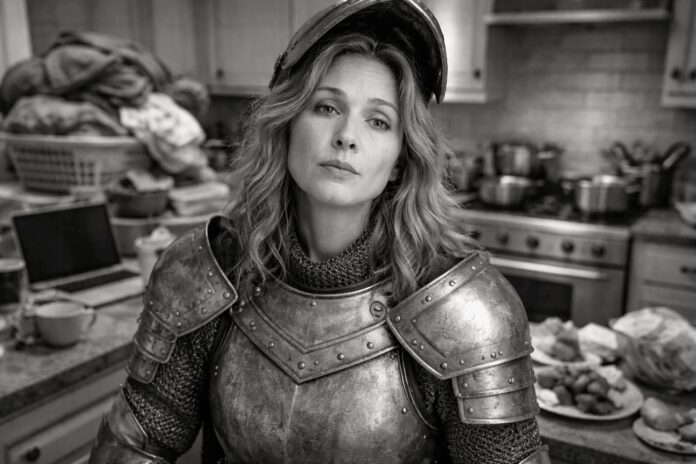
There is a kind of strength that gets noticed: decisiveness, resilience under pressure, the ability to lead in visible ways. And then there is the quieter kind, the one most often carried by women. It’s less about recognition and more about endurance. It shows up in the daily, largely invisible work of holding relationships together, anticipating needs before they are spoken, and absorbing emotional strain so that others don’t have to. For many women, this form of strength isn’t an occasional posture. It’s just life.
The Emotional Cost of Being the “Strong One”
Sociologists and psychologists have long noted that midlife is a period of “role accumulation,” when responsibilities converge rather than taper. Women are often simultaneously parenting, supporting aging parents, maintaining marriages, sustaining friendships, and contributing economically. According to research published through the National Institutes of Health, this layering of roles is associated with increased psychological tension and persistent mental load. One participant in a qualitative study described it with understated clarity: “I am always thinking about my children’s future.” That sentence captures something essential—not acute crisis, but chronic vigilance. The mind rarely rests, even when the body does.
This sustained cognitive and emotional labor has measurable consequences. Data from multiple studies show that midlife women report elevated levels of stress, anxiety, and depressive symptoms compared to earlier life stages. A widely cited study on burnout among women found that roughly one in five experiences high levels of emotional exhaustion, often tied not to a single domain like work, but to the cumulative weight of responsibilities across home, family, and community. Burnout, in this context, is not a dramatic collapse. It is a slow erosion—a dulling of joy, a shortening of patience, a fatigue that is not resolved by sleep alone.
Part of what makes this dynamic difficult to interrupt is that it is reinforced, not questioned, by the surrounding culture. In many communities, particularly faith-centered ones, strength is both affirmed and expected. Women are often praised for their reliability, their selflessness, their ability to “hold it all together.” These are not inherently harmful values. But when they become identity markers rather than occasional practices, they can narrow the space for emotional honesty. Strength becomes less about capacity and more about constancy. There is little room to step out of it.
Recent reporting has highlighted the scope of this quiet strain. A survey of women over 50 found that nearly two-thirds reported struggling with mental health challenges, yet the majority had not sought professional help. Many described a sense that they were simply expected to endure. The language is revealing: expected, not chosen. Endurance, in these cases, is less a virtue than an obligation internalized over time.
Endurance, in these cases, is less a virtue than an obligation internalized over time.
The emotional cost of this expectation is not always immediately visible. It accumulates in subtler ways, such as in the unspoken resentment that follows chronic overextension, in the disorientation of realizing that one’s own needs have become difficult to articulate, in the gradual thinning of emotional reserves. Researchers who study long-term stress note that these patterns often develop incrementally, with individuals adapting to increasing levels of strain until the baseline itself has shifted. What once would have felt unsustainable begins to feel normal.
Within a Christian framework, the tension can be particularly complex. Scripture calls believers to bear one another’s burdens, to serve sacrificially, to persevere in hardship. These are central tenets of the faith. But they are sometimes lived out in ways that conflate faithfulness with emotional suppression. The Psalms offer a counterpoint with texts filled with lament, confusion, even anger. “How long, O Lord?” is not the language of someone who has it all together. It is the language of someone who refuses to hide their need from God.
There is a distinction worth recovering here. Strength, in a biblical sense, is not the absence of vulnerability; it is the willingness to remain engaged with God, with others, and with truth, even when that engagement requires honesty about one’s limits. The Apostle Paul’s admission that “when I am weak, then I am strong” is not rhetorical flourish. It is a reframing of strength itself, one that resists the idea that human sufficiency is the goal.
What complicates this for many women is that their roles often place them at the center of other people’s stability. To acknowledge personal strain can feel like introducing instability into systems that depend on them. There is a legitimate concern embedded here. Families and communities do rely on these women. But the assumption that the system will collapse if they are not consistently strong is rarely tested and often untrue. More frequently, what is at risk is not the system’s survival, but its comfort.
Psychologists who study caregiving dynamics note that sustainable care requires reciprocity, even if it is uneven. When one person consistently occupies the role of giver, without pathways to receive support, the imbalance becomes a source of strain rather than strength. Over time, this can lead to what researchers call “compassion fatigue,” a state in which the capacity to care remains, but the emotional energy to do so is depleted.
None of this suggests that strength itself is the problem. The issue is not that women are strong, but that strength has been defined too narrowly—and practiced too continuously. There is a difference between choosing to be strong in a moment of need and feeling required to be strong at all times. The former is an act of agency; the latter can become a form of quiet constraint.
RELATED: Why Are So Many Christians Deconstructing Their Faith?