


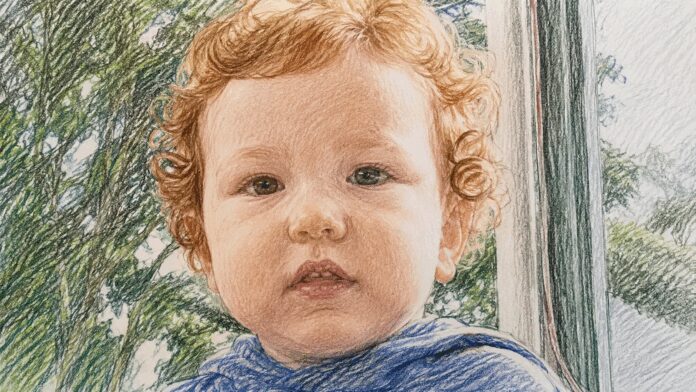
What began as an ordinary day became a medical nightmare almost instantly for the family of toddler Dusty Wildman.
The Australian boy was critically injured after inhaling a metallic cake decorating powder while his mother prepared a birthday cake in her home baking studio. According to reports, the powder entered his lungs and mixed with moisture, creating a paste-like substance that severely and almost instantly blocked his airways. Doctors rushed the 14-month-old into emergency treatment and eventually placed him into a medically induced coma in an effort to save his life.
Toddler Dusty Wildman’s Story Spreads Around the Globe
The story has spread rapidly online because it touches a fear most parents understand at gut-level: the terrifying reality that danger can emerge in the most ordinary moments. There was no reckless behavior involved, no obviously hazardous environment. A mother was baking a cake. A toddler was nearby. In a matter of seconds, an everyday household product became life-threatening.
Dusty’s mother later described the horrifying moment to reporters. “I thought he had eaten it,” she said, explaining that she initially did not realize he had inhaled the fine powder into his lungs. As his condition rapidly deteriorated, the situation became far more serious than anyone first imagined.
The powder involved was a decorative metallic dust often used to add shimmer or shine to cakes and desserts. Some versions of these products are labeled “non-edible,” even though they are frequently sold alongside baking supplies. Australian authorities later recalled certain metallic decorating powders after concerns emerged about ingredients that may have included copper and zinc compounds. But beyond questions about the product itself, medical experts noted another danger: ultra-fine powders can be especially hazardous when inhaled by small children because the particles travel deeply into the lungs and are often paired with caking agents.
According to the family, Dusty’s breathing worsened rapidly after the exposure. A family friend told People that doctors discovered the powder had essentially “turned into a paste” inside the toddler’s lungs. He underwent emergency surgical procedures as medical teams worked desperately to remove the blockage and stabilize his breathing.
Dusty was eventually placed into a medically induced coma while doctors treated the severe lung damage. During the ordeal, his mother said she felt consumed with fear and helplessness watching her son fight for his life.
Weeks later, the family shared encouraging updates that Dusty had survived the immediate crisis and was breathing on his own again. However, doctors warned he may suffer permanent lung complications because of the extent of the injury. A family friend told People that while the toddler’s progress had been remarkable, “the damage to his lungs is lifelong.”
Stories like this resonate deeply because modern parenting often operates under an impossible expectation: that good parents should anticipate every conceivable danger before it happens. Social media has intensified that pressure. Every tragic story is followed by thousands of comments from strangers insisting they would have done something differently. But the truth is that parenthood unfolds in real homes, during real life, amid distractions, fatigue, chores, work, celebrations, and ordinary moments that do not arrive with warning labels attached.
Toddlers move quickly. They grab objects unexpectedly. They put things in their mouths before adults can react. Most parents can remember a moment when their heart dropped after realizing a child had gotten into something dangerous for only a split second. Usually those moments end with relief. Occasionally, they do not.
That reality is difficult partly because it exposes how fragile life actually is. Parents work tirelessly to create safe environments for their children, but complete control remains an illusion. We install cabinet locks, research car seats, read ingredient labels, and monitor screens, yet many of the most serious accidents still emerge from situations that initially appear harmless.
For Christian parents, stories like Dusty’s can also stir spiritual questions that sit just beneath the surface of family life. One of the hidden burdens many mothers carry is the belief that vigilance alone can guarantee safety. But eventually every parent discovers the limits of human protection. We cannot watch every movement. We cannot predict every accident. We cannot fully shield the people we love most.
That realization can produce anxiety, but it can also produce humility. Scripture repeatedly reminds believers that human beings are not ultimately sovereign over life. Psalm 127 says, “Unless the Lord watches over the city, the guards stand watch in vain.” The verse is not an argument against responsibility; it is a reminder that even our best efforts have limits.
In the aftermath of Dusty’s hospitalization, many parents online responded not merely with shock, but with recognition. They saw themselves in the kitchen. They imagined their own little child nearby. They understood how quickly an ordinary afternoon could become a lifelong dividing line between before and after.
The story also raises important questions about product labeling and consumer awareness. Many parents assume that items sold in baking aisles are reasonably safe to use around children. Yet decorative products, supplements, essential oils, detergents, magnets, batteries, and dozens of other common household items can become dangerous under the wrong circumstances. Greater clarity from manufacturers matters. Better warnings matter. Honest public conversations about hidden household hazards matter, too.
RELATED: 13 Things Parents of Mentally Strong Kids REFUSE to Do