

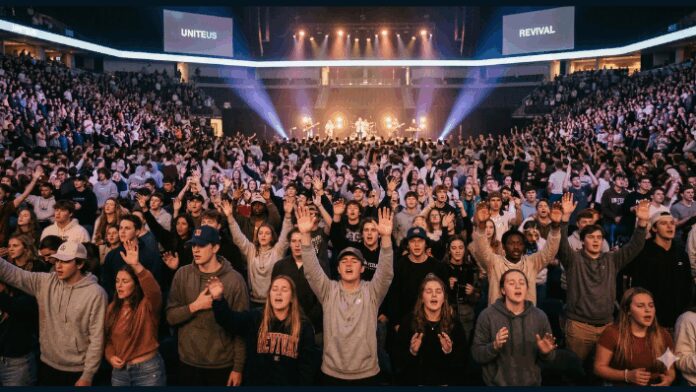
A Generation Searching for Meaning
For decades, surveys have suggested declining religious affiliation in the United States, especially among younger adults. Yet these campus gatherings suggest a more complicated story.
Many students involved say they’re searching for meaning in a world marked by anxiety, uncertainty, and cultural upheaval.
“Purdue is a very academic campus and it is very easy for people to feel lonely or anxious,” one student organizer said. “We are trying to plug people into community and let them know that they are seen and loved.”
In that sense, the appeal of these gatherings goes beyond theology.
They offer belonging.
Students arrive expecting a worship service, but many leave having experienced something deeper—a sense of shared spiritual hunger that has become increasingly rare in an age dominated by screens and social media.
The Influence of Recent Revivals
Observers also note that this wave of campus gatherings follows closely on the heels of the widely publicized revival at Asbury University in Kentucky.
In February 2023, what began as a routine chapel service turned into days of continuous prayer and worship, drawing thousands of visitors to the small Christian university.
Videos of students praying, singing, and confessing faith spread rapidly across social media, sparking similar prayer gatherings in churches and campuses across the country.
While the current campus movement is not directly tied to Asbury, many leaders say the revival helped awaken a renewed expectation that spiritual renewal could happen among young people.
In other words, students began to believe revival wasn’t just something found in history books.
It could happen now.
The Leaders Behind the Movement
Many of the large gatherings are organized through UniteUS, a ministry effort launched in 2023 with the goal of sharing the gospel with college students.
The movement traces its origins to an event at Auburn University, where 5,000 students gathered for worship and 200 were baptized in a nearby lake afterward. Since then, leaders have hosted large-scale events across the country. Yet organizers repeatedly emphasize that they don’t see themselves as the source of the movement.
“It’s the hand of God,” said UniteUS founder Tonya Prewett in describing the gatherings. “It’s way bigger than us.” Others involved in the movement say the gatherings work because they are simple.
There are no complicated programs or celebrity-driven experiences—just worship, prayer, and a clear presentation of the gospel. And for many students, that simplicity is part of the appeal.
RELATED: Why Are So Many Christians Deconstructing Their Faith?
A Revival—or Just a Moment?
Whether historians will ultimately call this a revival remains to be seen. Religious awakenings are often easier to recognize in hindsight. But the early signs are intriguing.
Across the United States, large numbers of students are voluntarily attending worship gatherings, publicly professing faith, and participating in baptism—something that seemed unlikely just a few years ago.
The movement has also spread organically. Students who attend one gathering often return to their campuses and start prayer meetings of their own.
Which brings the story back to where it started. Not with a stage or a crowd, but with a few students praying.
And if the pattern continues, that may remain the movement’s defining feature: revival that begins not in arenas—but in quiet rooms where a handful of believers simply ask God to move.
Because sometimes, the most powerful movements start with just one prayer.